

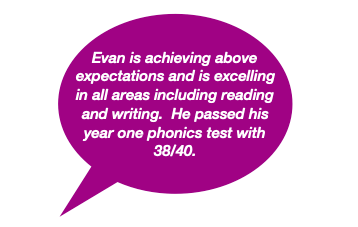
(School Report summary by year 3)
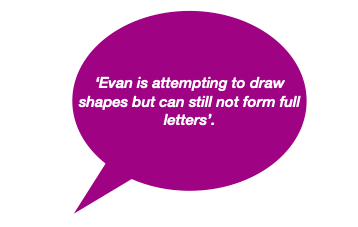
(School report, year 4, age 8)
In the summer holidays between year 3 and year 4 something unknown happened to Evan. By October, Evan1 was spending much of his time in school highly distressed. He frequently hallucinated, had toileting accidents, had become acutely sensitive to sound, felt that something terrible was happening to those he loved and, once a fluent writer, could no longer copy a simple learning objective from the whiteboard.
From both excelling in and loving school, Evan had now been referred on the pathways for OCD, anxiety and sensory needs. He also now required a teaching assistant to scribe for him. Once popular and engaged, he was struggling to remember the day of the week, and to maintain any control over his emotions. He had developed tics and was reporting that his food was contaminated. His friendships had crumbled. Evan just wanted the safety of being at home and close to his parents.
Yet none of the emerging signs of these issues had been noticed by either his family or professionals. Evan’s developmental history was unremarkable. There had been no concerns around concentration, anxiety, learning, or any evidence of sensory needs. No traumatic events had occurred over the summer holidays.
How could so many severe needs have remained hidden and then suddenly implode?
PANS and PANDAS
Unbeknown to either the school or his family, Evan had developed a little known but increasingly recognised post infectious disorder known as PANS or PANDAS. This followed an illness in the summer holidays from which he had quickly physically recovered. Evan’s needs hadn’t been hidden; they had not been present until he developed a condition that affected his brain.
PANS (Paediatric Acute-onset Neuropsychiatric Syndrome) and PANDAS (Paediatric Autoimmune Neuropsychiatric Disorders Associated with Streptococcal Infections)
are post infectious conditions that can affect both physical and mental health. They often occur in children with onset typically between the ages of 3 and 13, but PANS can also affect adults, and the conditions do not suddenly stop at 16. Historically families have experienced a lot of difficulty in accessing help but recent progress is bringing new hope that children and young people will begin to be treated more quickly.
How do these conditions affect children and young people (CYP) in school?
Like Evan, CYP with PANS and PANDAS can abruptly go from doing well in school to experiencing a range of difficulties affecting different areas of their development.
These can include developing obsessive thoughts and behaviours, tics, anxiety, behaving in a younger way, sensory needs, eating issues and problems sleeping. In some cases, CYP can develop unexpected special educational needs.
While our current understanding is still evolving, available evidence suggests that early identification leads to better outcomes, and schools have a crucial role in spotting the early signs. The psychological and physical impact on CYP can be profound when symptoms are misconstrued, treatment is deferred, and children undergo a very changeable regression in skills without clear explanation.
Whilst Evan’s teachers and his family all focussed (understandably) on his extreme anxiety, sensory needs and OCD, it may well have been that one of his ‘quieter’ symptoms, the deterioration of his writing skills could have provided a vital clue. Assessments underpinning the impairments of Evan’s writing may well have also revealed some additional information about changes in executive functioning or fine and gross motor skills. These do not abruptly deteriorate in a solely mental health disorder for example.
Not every child with PANS or PANDAS will undergo a change in their writing skills, but this is a commonly reported difficulty. Dysgraphia also appears in the diagnostic criteria for PANS as one potential symptom alongside sudden deterioration in school performance.2
Writing
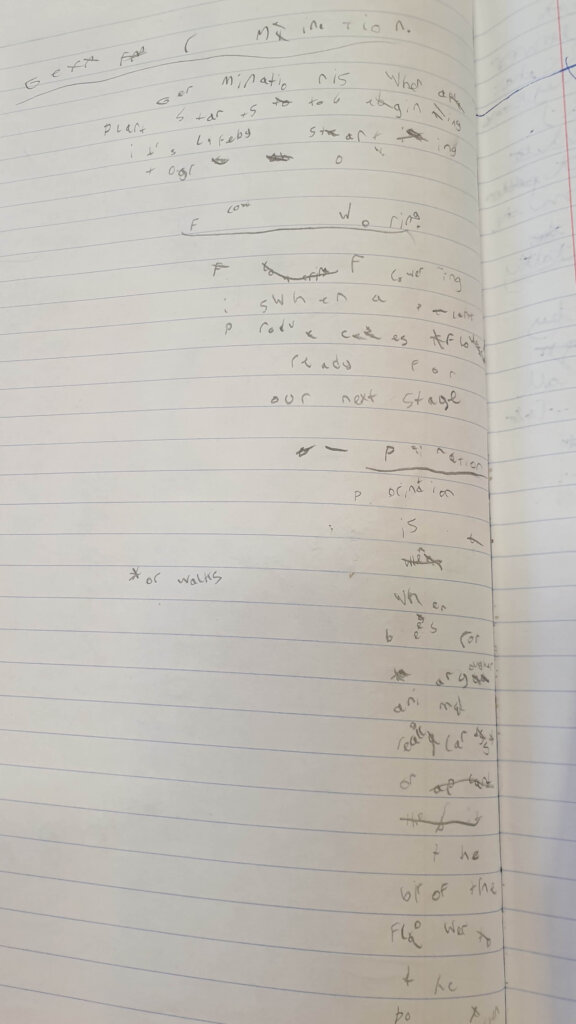
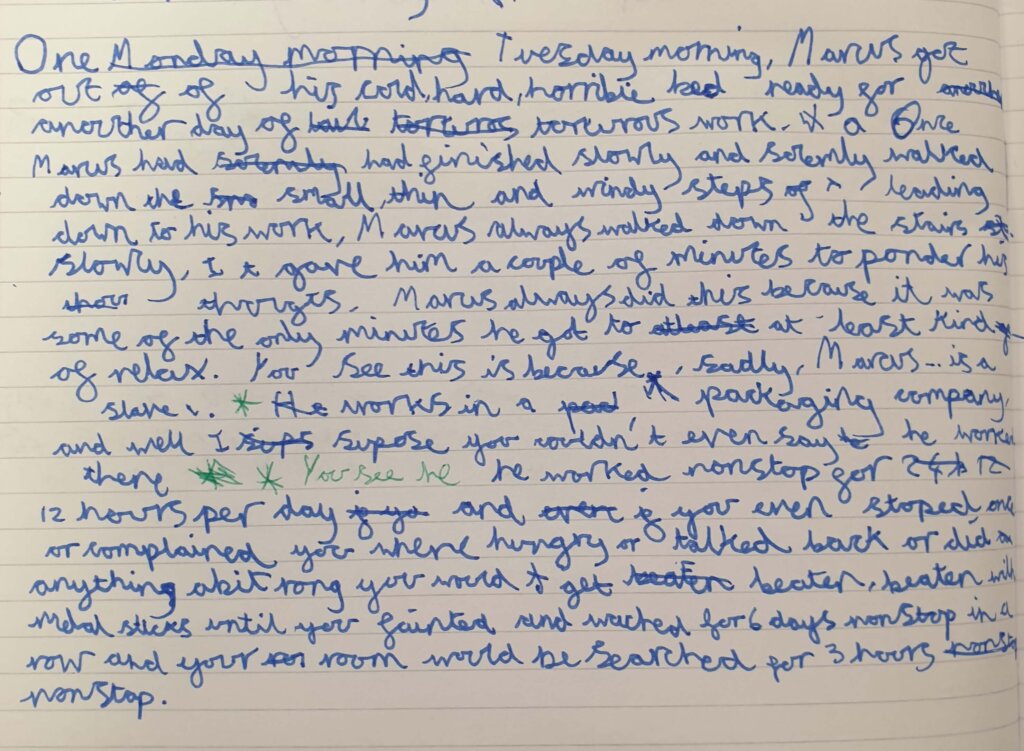
Examples of writing from children with PANS/PANDAS suggest that there are a wealth of new onset writing issues including changes in spacing and positioning, spelling, the appearance of a margin drift, changes in the quality and amount of the content, reduced levels of accurate punctuation, and letter formation issues alongside inconsistent sizing and pressure.
Spotting the signs of PANS and PANDAS related writing difficulties in comparison with dyslexic type writing difficulties
PANS and PANDAS | Dyslexic type writing difficulties |
|---|---|
| Sudden onset of writing changes accompanied by other social, emotional, physical and cognitive impacts Discrepancy between current standard of writing and past school assessments and reports Lack of earlier developmental signs Marked comparison in pre and post onset writing samples Margin drift can be a sign Relapsing and remitting pattern Change from an even cognitive profile to a spiky profile- changes in executive functioning/working memory, auditory, visual processing skills Changes in fine or gross motor skills, which in some cases is accompanied by a regression in drawing skills | Writing can seem to deteriorate over time, particularly as the demands of the curriculum and requirement to work at speed increase (e.g. move to a new Key Stage in school). For example, CYP with dyslexia may: – Increasingly sacrifice once learned handwriting skills to the need to get content down on paper – Increasingly struggle with the working memory skills required to plan and hold ideas in mind – Struggle with increasingly complicated spelling. However, unlike PANS and PANDAS: – Writing deterioration is not extreme/sudden – There would always be a background history of difficulties/spiky profile where dyslexia is present – Dyslexia is persistent and does not relapse and remit |
The role of educators in identification
As an educator, if you observe dramatic changes in a CYP following an infection, it’s worth being aware of the potential marker of writing challenges. The signs of PANS and PANDAS can often be mistaken for neurodevelopment, psychiatric, or behavioural conditions rather than as a medical condition. CYP can get better. Many of the symptoms of PANS and PANDAS roar loudly and can easily become the sole focus, but it may be the equally devastating but quieter changes in writing and executive functioning that guide you towards the right path.
Where can I access further information and support?
For more medical and general information please go to the PANS PANDAS UK website- https://www.panspandasuk.org
For education resources including the option for schools to attend free teacher training – https://www.panspandasuk.org/education
For an overview of the current health and education context – https://www.edpsyched.co.uk/blog/pans-and-pandas
Useful Resources
‘Fine Motor Skills & Handwriting Deterioration in PANS PANDAS’.. (2021). ‘Fine Motor Skills & Handwriting Deterioration in PANS PANDAS’. Aspire.
Footnotes
- Evan’s case story is not one story but taken from experiences of a range of children. ↩︎
- Dysgraphia falls into the minor criteria category for PANS, for which two must be present (alongside one of the major criteria of acute onset OCD or severely restricted food intake)
– Sudden Deterioration in School Performance (due to difficulties with memory, concentration, hyperactivity, impulsivity, new deficits of visuospatial skills)
– Motor or Sensory Abnormalities (dysgraphia, clumsiness, tics, new sensory sensitivities to light, noise, smell, taste or texture). ↩︎


