

Often I am asked what strategies can be used to support a child with dyslexia in intervention and at home. There are many excellent commercially available reading and spelling intervention programmes, and it’s hard for parents and practitioners to know what to buy, how to use it, and whether they can justify the cost. There is never a straightforward answer, as it depends so much on the child and what has already been done, and it’s rare that any one programme or resource meets every need. In my many years’ experience of advising on intervention, I have found that generic, multi-use, free and easily made games are my go to recommendation – and here’s why.
Everyone learns through play
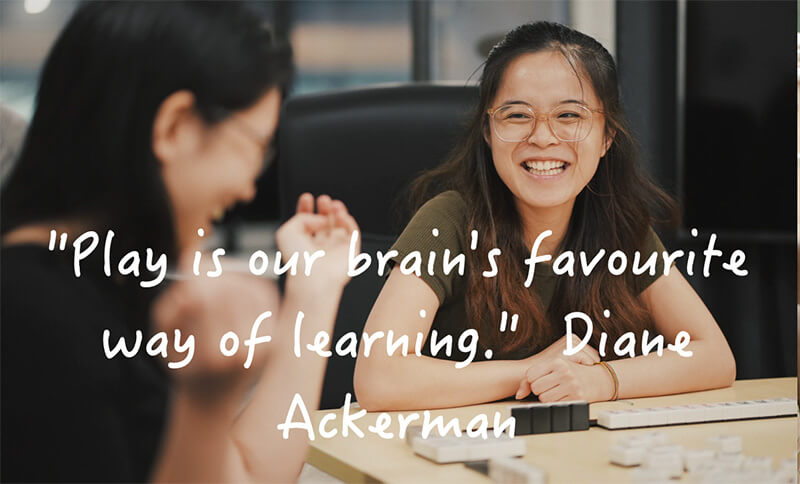
When we think of learning through play, we often think of pre-school and the early years, but evidence tells us that everyone, whatever their age, can learn through play. When we are having fun, we are relaxed and in a better position to engage fully with learning. Research tells us that human memory works best when it has something meaningful, preferably with an emotional connection, to remember. Therefore, placing the tough things our learners need to learn at the centre of a game is not only a lot of fun, but it is proven to be an excellent teaching tool.
Multi-Purpose games meet the needs of the dyslexic learner
There are three main areas of need for learners with dyslexia or persistent literacy difficulties that can easily be met with multi-purpose games. These are:
- The need for need multiple opportunities for over learning. It might take more than ten times as long for a tricky spelling, for example, to be committed to the long term memory as it would a for other learners. Multi-purpose games automatically build this in without the repetition becoming dull and demoralising.
- The need for multi-sensory learning opportunities. The simple act of talking about a spelling in a game and doing something with it, whether that’s writing it on a Bingo board or putting it in a pair, instantly renders it more multi-sensory than simply writing a list of words. The more you play with words using more than one of the senses, the more you are activating different parts of the brain and engaging in metacognition (thinking and talking about learning). This type of learning, we know from research, is far more likely to stick!
- The need to teach what needs to be learned. If a child has gaps in their phonics, reading and spelling, the gap needs to be specifically addressed. These gaps are rarely the same for every child. The nature of dyslexia is persistence, and the areas of difficulty are rarely learned by osmosis – they need to be specifically taught. Multi-use games, designed to be used in multiple ways, are a really practical way to rehearse what the learner needs, because they enable you to choose exactly which words you’d like to target.

Games are a great way to build fun into learning, and they can be adapted to each learner’s need, so they are great for home learning too. All you need is a multi-use game along with the words/material that needs to be taught (you’ll know this from the school’s assessments and observations or from homework tasks), a few counters, something to write with and on, and some blank cards, and you’re good to go!
Multi-use games: some ideas
There are many types of multi-use games; only some are detailed here. They can easily be made from scratch in school or at home, and some templates are downloadable below. For future similar freebies, sign up for my newsletter on www.louiseselbydyslexia.com.
These games can all be adapted to many areas of learning, but our focus here is reading and spelling, whether that is graphemes for phonics (the written letters that make one speech sound, e.g. oa, igh, air), common exception words (those words that can’t be sounded out using phonics) or morphemes (units of meaning – prefixes, suffixes, roots).
1. Tic tac toe/4 in a row (downloaded template available)


Use as a quick activity to practise anything! For example:
Reading letters, graphemes, morphemes or words. Write the target word/letters on the boxes in advance, and take turns to read one – if correct you can mark the square
Writing letters, graphemes, morphemes or words. In advance prepare a set of cards on which are written your targeted words/letters. One player reads a card; the other player must write it correctly in an empty box on the grid.
Alternatively, laminate the board and use whiteboard markers or counters with a separate piece of paper for writing the words.
2. Bingo (downloaded template available)

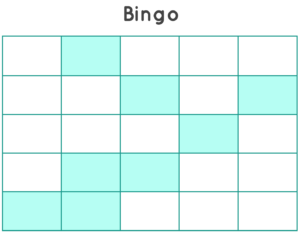
Write your targeted words/morphemes/phonemes on cards. Each player has a bingo board, and writes some of these words (choose the number or words in advance) on their board. The shorter you want the game to be, the fewer words you’ll have. Put the cards in a bag or box. One person pulls out a card from the box/bag and reads it aloud. If any player has this word on their board they put a counter on it, or write a line through it. First to get 3 covers/a line/ a full house is the winner.
Laminate for recurring use and use a whiteboard pen.
Games using cards
For all these games, you just need two set of blank cards on which you have written the spellings/words/graphemes/morphemes that your child needs to learn.
4. Snap
Shuffle your cards and take turns to pick up a card, turning it over so that everyone can see it. If the card is the same as the previous card, the first player to shout “snap” gets a turn. The winner is the player who gets all the cards, or who has the most cards once you’re fed up with playing!
5. Word Families Snap
Adapt Snap for word families (phonics or morphology) – players can shout snap if the two words contain the same phoneme or morpheme. E.g. pair and hair, fight and sight, main and pain (phonemes) or wanted and seated, countless and helpless, automatic and automobile (morphemes).
6. Pairs
Place the cards face down on the table, so that the back of each card is visible, and ensuring that they are the right orientation for reading when turned over. Take turns to pick up two cards, and if they match, you can keep the pair. The player with the most pairs once all cards have been played is the winner.
7. Word Families Pairs
Play pairs (as above) but in this game a matches when words are in the same families in the same way as Word Families Snap.
8. Odd one out
A game for teaching two spelling rules/phonic patterns/word families (phonics or morphology)
You’ll need one set of cards for each word family or rule you are practising (e.g. all the words containing -ness and all the words containing -est, or all the words containing ure and all the words containing au). Take turns to place any 3 cards on the table – is there an odd one out? (For example if the cards say kindness, fairness and darkest, darkest is the odd one out because the other words contain -ness). Or if the words say pure, sure and haunt, haunt is the odd one out). If there is an odd one out you get to keep the cards. Play until you have run out of cards.
9. Headbands (downloaded template and ideas available)
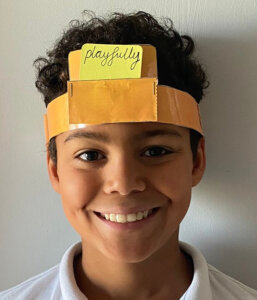
A game to practise word investigation/spelling and vocabulary (see download for more ideas). You’ll need to make a headband for each player and make some word cards for the words you want to focus on. This game is great for morphology (prefixes, suffixes and roots) but can be used for anything!
Game 1: All answers must be “yes” or “no” Each player (or just one player) is given a word or phonic pattern on a card which is placed inside the envelope, so that other players can see it but no-one can see their own card. Players take turns to ask questions about their word. The winner is the first to guess what it is. For example: if players have a word containing a root, prefix and suffix, a question might be “does it contain the suffix -est?. If the players have a word containing a phonic pattern, they could ask “Does it contain the ai grapheme?”
Game 2. Set answers Play in the same way as game 1 but allow worded answers to questions.
To rehearse spelling using Headbands, players must write down their word with the correct spelling once they have guessed it.
10. Dice and spinner games (downloaded template available)

These games can be played be played with 2 dice – just put blank stickers on each side and write your targeted words/letters on each one – or any dice app (I use Make Dice Lite but others are available). Alternatively, two blank spinner bases (examples above) could be used with clear spinners (available from Crossbow Education for approximately £5)
This game can be played to practise morphology (roots, prefixes and suffixes), phonics or spelling rules. Write 6 morphemes (e.g. -y, -er, -ness, -ed, -es, -est), phonemes (e.g. oa, or, ear, ar, er, ur) or spelling rules (e.g. double consonant, silent letters, etc) on each side of one dice, and on the other dice write words that contain these morphemes, phonemes or spelling rules. Roll the dice and if you get a match you can have a point.
>> Download Dice and Spinner Games
11. Race games
Any general race gameboard (e.g. Snakes and Ladders, Ludo) can be used to make learning spellings more fun. Take turns to read a word to the other player and ask them to write it down. If they are correct, take a turn on the game board.
This game can be adapted to teaching word families – how many words can each player think of in a word family you have been teaching? (e.g. words containing ight, or un-). Move that number of spaces.
12. Guess the word
A really simple game that can be adapted for absolutely anything needing practice. Use a bag or box and place cards in it on which are written words, morphemes or graphemes. Write the same words, morphemes or graphemes on a whiteboard or paper. Players have a minute or so to look at them, then cover them. Each player must choose one from the list they have just looked at and write it down on their own paper/whiteboard. One player picks a card from the bag or box. If that is your word, you get a point.
Instead of a bag or box, you could use turned over cups or anything that takes your interest!

There are endless other possibilities for games which are free and easy to use and adapt. I’ll be creating more multi-purpose game boards in the coming months which will be available to all my newsletter subscribers – subscribe now using the form below to ensure you don’t miss out!
No go, and have some fun!


