My dyslexic son never learned his multiplication tables, but he has just graduated with a Masters in engineering.
– Laura, Parent
dyslexia, dyscalculia and maths
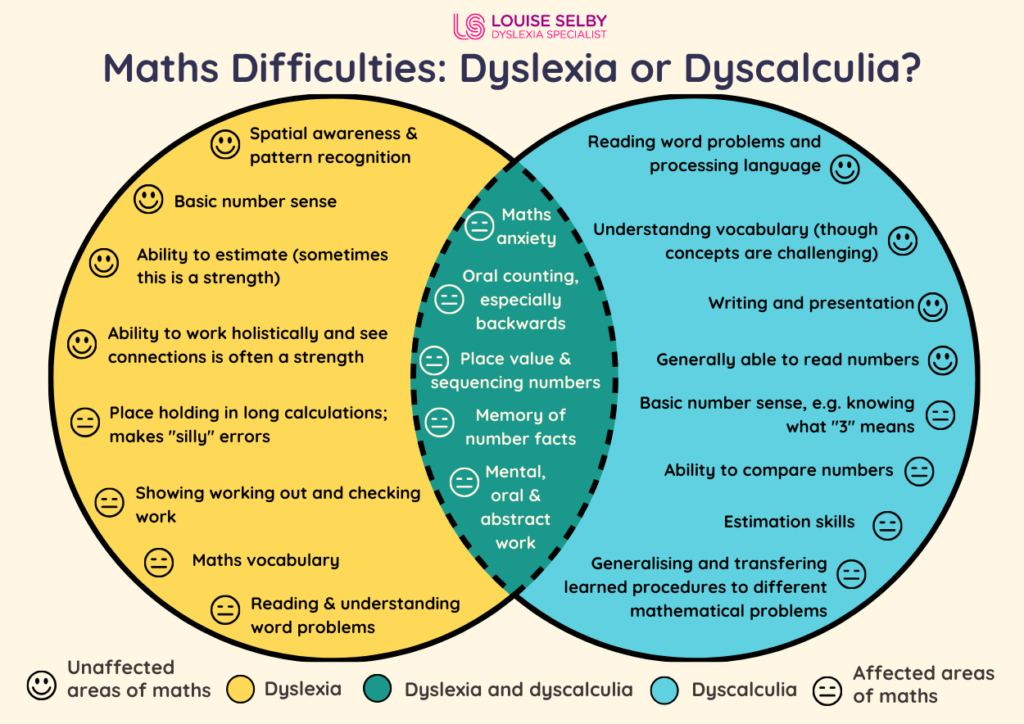
Dyscalculia impacts basic number sense. Learners with dyscalculia usually have severe difficulties with aspects of arithmetic and calculation. They lack an intuitive understanding of relationships between numbers and therefore struggle with comparison and understanding size of numbers. They struggle to generalise what they have learned, for example a method of calculation, and therefore they tend to rely on memorising procedures, which they may not understand, and rote learning.
Dyslexia, on the other hand, does not impact basic number sense. In fact, many dyslexics can estimate and compare numbers well, and work intuitively. However, reduced processing speed and working memory difficulties, both associated with dyslexia, mean that it’s hard to follow and keep up, especially when required to work mentally. Oral counting, sequencing, and working backwards can be very challenging. Calculations which require you to hold information in your head whilst you work on it are also problematic. Maths fluency is often a problem for dyslexics; they can get there but need more time.
I really struggle with Maths. The teacher says things but I can’t follow them and I get lost.
– Caroline, age 8
Sometimes I read the question well but I get the numbers mixed up, so I read 1, 0 8 but say 180.
– Brandon, age 11
Maths and Science A Levels are an absolute working memory and executive function spaghetti soup.
– Helen, adult
As you’ll see in the Venn diagram, while there are differences between maths difficulties resulting from dyscalculia and those caused by dyslexia, there are also some overlaps. Both involve difficulties with memory, oral counting and ordering numbers. Both mean that learners are likely to struggle with the abstract, and to work best with concrete learning and multiple over-learning opportunities. Both are often the cause of maths anxiety at some point in their schooling (and sometimes beyond). Whatever the cause of a learner’s maths difficulties, what matters the most is accurate assessment of where each learner’s difficulties lie, so that helpful strategies can be put in place.
1. Practise oral counting daily
Oral counting, forwards and backwards, in different steps according to ability, is essential and not just for young children. Counting forwards in steps of 2, for example, could start at 0 (0, 2, 4, 6, 8, 10) 23 (25, 27, 29…), 71.3 (73.3, 75.3. 77.3.)… Backwards counting could start at 10, 99 or 100.3. Whatever the level, regular oral counting is extremely valuable rehearsal. Where possible, include visual prompts and manipulatives, for example number lines and bead strings. Counting activities can involve jumping, actions or throwing a ball to add interest and movement.
2. Use manipulatives and visual aids
Again this is not just for younger children! Encourage the use of fingers (there are ten of them for a good reason!), place value concrete apparatus, coins, counters, digit cards, and use highlighters, arrows, diagrams, colour. Abstract maths concepts need to be embedded in understanding for real learning to take place. Visual aids for vocabulary, procedures and facts are a huge help.
3. Provide word banks for vocabulary
Word charts and table top aids can be provided to help, for example the language of maths posters linked here. Pre-teaching can be useful for supporting vocabulary.
4. Support with word problems
There is so much unravelling to do when presented with a word problem. To help, use colour coding and word charts to support interpretation. Teach learners to visualise or play a mental movie of a word problem to help them understand. Encourage learners to read word problems aloud and talk about them, discussing possibilities. Help them to make notes of key information.
5. Practise and support number facts
There are two problems with number facts. Firstly, learning them in the first place! your learners with dyslexia and dyscalculia are likely to need multiple opportunities for overlearning. Games are a great way to do this, and I have written a blog about this with some free resources. The second problem is relates to cognitive load: with so many cognitive plates spinning it can be difficult to recall and hold the number fact required. Providing visual aids and notes reduces this load.
6. Support or avoid purely mental maths!
Avoid asking dyslexic learners to do work which is purely mental/oral. Support with visual aids and movement. Provide strategies for note taking during mental maths tasks.
7. Allow time
For learners with reduced processing speed, they’ll get there – just not as quickly. Develop a culture where spending time to check and be accurate is encouraged.
8. Chunk instructions and make them visual
Step by step, chunks, pictures, and even media recordings can help reduce the load.
9. Support reading of words and symbols
Colour coding can be invaluable here (see link above). Use visual aids and mnemonics to support learners in distinguishing between similar symbols.
Maths difficulties can be relieved or even overcome, but it’s important to know the cause. Is it processing speed? Is it memory? Is it basic number sense? Is it vocabulary? You’ll save yourself a lot of time and your learner a lot of stress if you can work this out and plan accordingly.
Useful websites
The Difference between Dyslexia and Dyscalculia