

The Early Reading Framework in a nutshell
In July 2021, the government released new guidance on reading in The Early Reading Framework. The main points, as they relate to teaching word reading (phonics), are:
- All children should be taught systematic synthetic phonics (SSP) should be taught without exception.1
- Until phonics is completely secure, children should ONLY read decodable books.
- Do not teach “high frequency words”, unless they are not decodable. Non decodable words are linked to the curriculum and known as “common exception words”. Any other words must be taught using synthetic phonics as they are decodable.
- Schools should stay faithful to one approach; use a scheme and stick to it – this can be Letters and Sounds but additional and compatible resources are necessary
- Additional intervention for children with special educational needs should be based on synthetic phonics2
Should we get rid of all books which are not purely decodable?
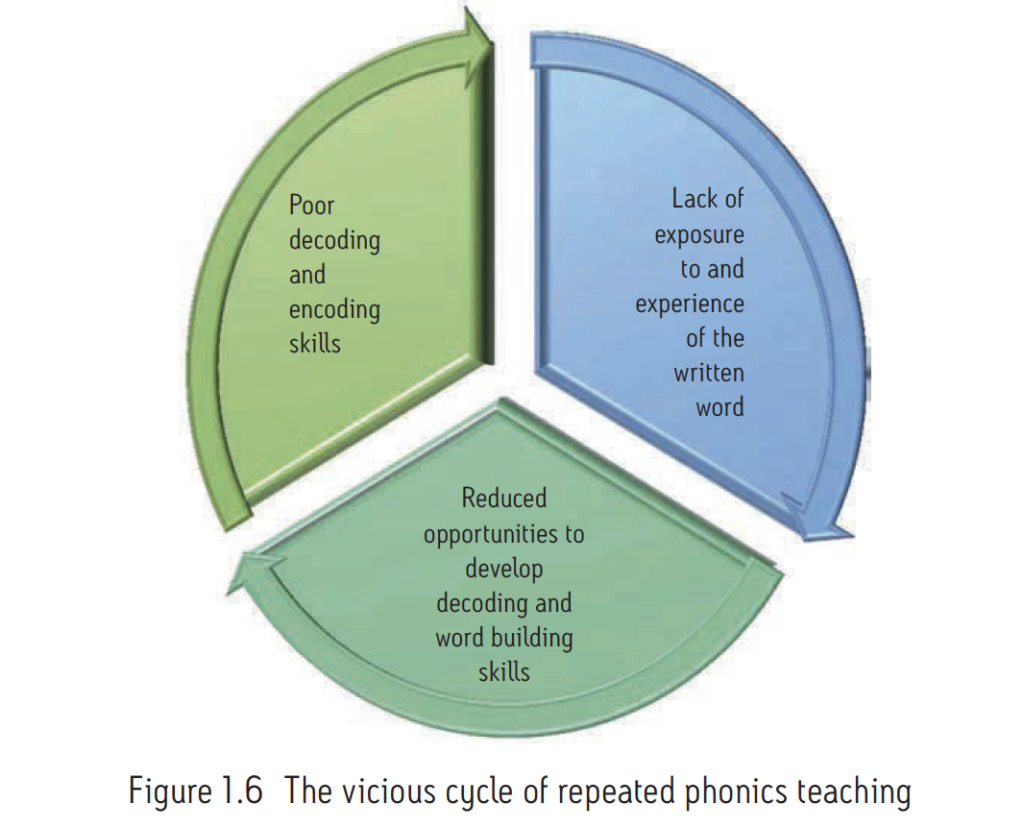
My first concern relates to the sole use of decodable books for children in Key Stage 2 who have not grasped phonics. It’s well researched that children with dyslexia find phonics tricky. I don’t disagree with the Framework that they still need to learn it, and that their reading books should match their progression. However, I have seen first hand that they also need books which allow them to use their strengths; they need to use pictures to look for clues, find repeated patterns in books and use their understanding of syntax and meaning to work out words. Michael Rosen could have been speaking for a child with dyslexia when he said “Meaning is also conveyed through ‘prosody’ – the rhythms, sound-patterns, repetitions, variations within in the musicality of a Text”.3 Forcing these children to put aside their strengths to read purely decodable books, which are pitched at much younger children, is setting them up to fail, and this lack of exposure to print can lead to reduced passion for language and stories, becoming a vicious cycle as illustrated in Figure 1.6.4
Should intervention for struggling readers be purely synthetic phonics based?
My second concern relates to the disregard for other other forms of research-based reading intervention for those with reading difficulties. There’s a large body of evidence for the effectiveness of using of chunks of sound (onset and rime) in intervention, and also a growing and compelling body of evidence for the effectiveness of morphology (units of meaning), for learners with dyslexia. Many children work much better with units of meaning (morphology) than units of sound (phonology); making sense of words is often what dyslexics do well!
The downward spiral of language as a result of phonics, phonics and yet more phonics
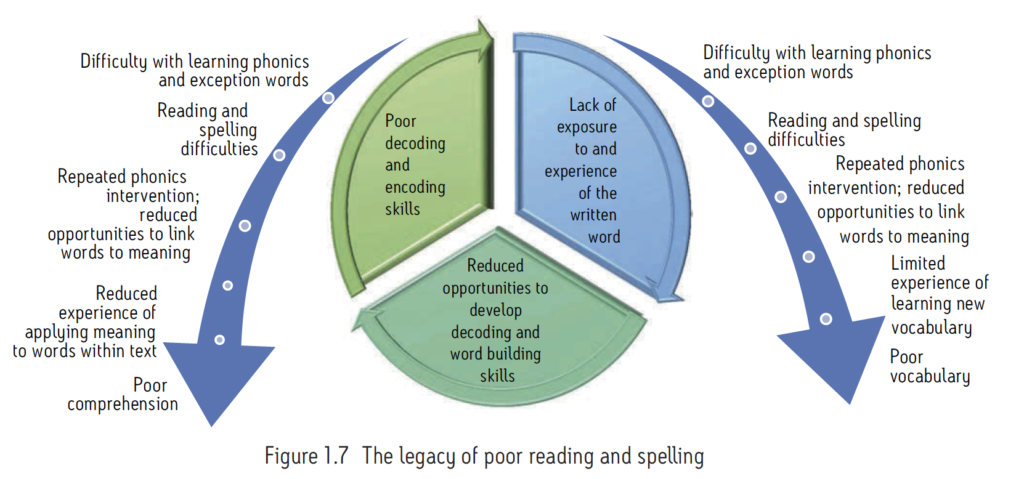
My real fear is that we will create a glut of dyslexic children whose early language abilities deteriorate as they are taught to bark at print, and who have disengaged with the wonders of words and meaning. Five years ago, having found repeatedly that children in year 6, who displayed fantastic vocabulary, comprehension and language skills in the earlier years, but who, after years of phonics intervention to address phonics difficulties, had plateaued in their vocabulary and comprehension skills (as illustrated in Figure 1.7), I wondered if there was a different way, a way which allows them to break words down and build them up according to meaning, not sounds. This was the birth of Morph Mastery.5
Don’t get me wrong, I welcome the Early Reading Framework. I love synthetic phonics. Appropriate book levelling is vital. Good quality first teaching rocks! But let’s not throw out the baby with the bathwater. I implore my colleagues and those in government to look at the evidence and research and consider the strengths and needs of 10% of our population who have dyslexia and be courageous enough to embrace their differences. There’s more than one way to open a door.
Footnotes:
- Synthetic phonics uses the purest forms of sounds (so pl is two sounds, p + l, while ai is one sound). It blends these sounds together to make words, and segments words into their individual sounds
-
For example, if a child has not learned to read the sound “ay”, the word play should not be in the reading book.
- http://michaelrosenblog.blogspot.com/2018/11/more-thoughts-on-reading-for-pleasure.html
-
Taken from Morph Mastery, a Morphological Intervention for Reading, Spelling and Vocabulary, Routledge, by Louise Selby
-
See note 4.
Further information
https://www.hertsforlearning.co.uk/blog/getting-forensic-phonics-ofsteds-focus-early-stages-reading
https://www.early-education.org.uk/news/guest-blog-helen-bradford-dfes-new-reading-framework


